
Overview
- General anesthesia (GA) is a medically induced state of unconsciousness used to facilitate surgery or other procedures.
- During anesthesia, your horse will not feel any pain, nor will they remember the events during anesthesia.
- Unlike sedation, general anesthesia is only accomplished once a horse is fully asleep and cannot move or feel pain.
- General anesthesia can be performed via injectables or inhalant gas. Inhalant gas anesthesia in large animals is often only performed in referral hospital settings due to the requirement of specialized equipment.
Signs & Symptoms
- Your horse may be anesthetized for surgical procedures that require complete immobilization, including elective procedures such as castration or arthroscopy, or for an emergency procedure such as colic surgery or complex wound repair.
- Although some procedures can be accomplished in the standing, sedated horse, general anesthesia may be recommended by your veterinarian for certain procedures that cannot be performed standing or for the safety of the horse themselves.
Diagnostics
- Your veterinarian will determine if your horse requires anesthesia and what type of anesthesia is best for the procedure.
- A basic pre-anesthetic evaluation of your horse will consist of a thorough physical examination including listening to their heart and lungs, taking their temperature, evaluating their medical history, and assessing their overall health prior to undergoing anesthesia.
- Your veterinarian may also recommend running pre-anesthetic bloodwork on your horse to determine the health of their internal organs and their ability to withstand an anesthetic event.
Treatment
Types of Anesthesia include:
- Inhaled (gas that is breathed in) and
- Injectable anesthetics (given in a vein).
- Injectable anesthetics are all given directly into the horse’s vein to induce anesthesia. These are often utilized when your horse is anesthetized at home, or for short procedures.
- Alternatively, inhalant anesthesia is often utilized in hospital for longer or more complex procedures. During inhaled anesthesia your veterinarian will place a breathing tube in your horse to allow for precise flow of oxygen and gas to maintain anesthesia.
- Anesthetic induction
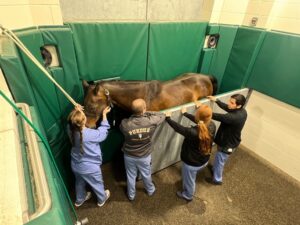
- Your veterinary team will assist your horse to lay down and to stand up from anesthesia (Figure 1). Some horses may require more help than others due to illness, lameness, or neurologic issues.
- Anesthetic maintenance and monitoring
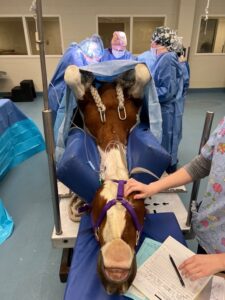
- Your horse will be precisely positioned on a padded table or a flat surface during anesthesia to prevent muscle soreness (Figure 2).
- A member of your veterinary team will continuously monitor your horse throughout the procedure (Figure 2).
- Anesthetic recovery
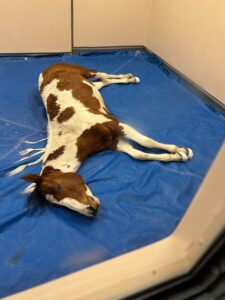
- Your veterinary team may assist your horse to stand after anesthesia or allow them to “free-recover” where the horse is allowed to stand on their own without intervention (Figure 3).
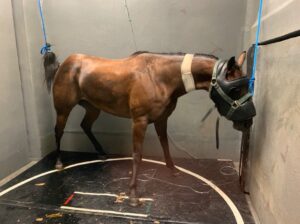
- For certain procedures your veterinarian may choose to “rope recover” your horse from anesthesia. This is a form of assisted recovery where ropes are used to guide your horses’ head and tail while they stand up (Figure 4)
Aftercare and Outcome
- Although uncommon, anesthetic complications can occur in horses, and all steps to prevent these events will be taken by your veterinary team. Complications may include: accidental injury including bone fracture, nerve or muscle injury, GI upset/colic, infections such as pneumonia, medication reactions and rarely anesthetic death.
- Depending on the procedure, your horse will require a recovery period after anesthesia that may require slow reintroduction of feed or rest for a short amount of time until the effects of the medications have worn off. Further rest and care for your horse will be dictated by the type of surgery performed, and your surgeon will make these recommendations.
Premier Sponsors