The “large colon” in horses is the equivalent of the ascending colon in humans. This portion of the colon is folded in a “U-turn” and has a large diameter compared to the rest of the intestinal tract. The two different tubes of the colon are attached to each other by tissue and move together in the horse’s abdomen. It is only attached to other structures at its base, and otherwise freely floats in the abdomen. It normally should start on the right side of the horse, run around the front of the abdomen, then run down the left side so that the “U” portion is on the bottom left side of the abdomen. A displacement is when the colon changes place from its normal position. It can float upward between the spleen and body wall-this is called a left dorsal displacement, or it can loop around to the right side of the abdomen, which is called a right dorsal displacement. It can also twist around itself, which is called a large colon volvulus. During a large colon volvulus, the blood supply can be cut off, causing death of some parts of the colon. A full, 360°, large colon volvulus is a medical emergency, whereas a displacement is generally milder and is usually not life-threatening.
Large Colon Displacement (Left or Right)
- Poor or no appetite
- Occasional or constant signs of colic (kicking, pawing, rolling, flank-watching)
- Decreased manure production
Large Colon Volvulus
Most commonly occurs in mares within the first three months in mares after having a foal but can happen to any horse.
- Severe pain is a hallmark sign
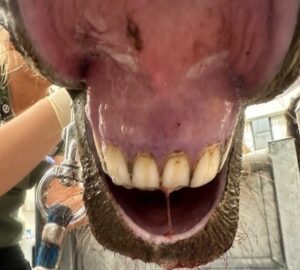
- Purple/dark gums
- Lethargy/listlessness
- Bloated appearance (abdominal distention)
- Shock-cold limbs, nose and extremities along with gum changes
With a full large colon volvulus with circulatory compromise, death can occur within four to six hours. Horses are usually painful even with medication.
A full colic workup is often performed, starting with:
- Physical examination to capture your horse’s heart rate, temperature and respiratory rate along with listening to the horse’s abdomen and chest and looking at their mucus membranes.
- Nasogastric tube may be passed up the horse’s nose to check for reflux, which can provide the horse with relief if there is pressure in the stomach or reflux (vomit).
- Rectal examination: Displacement and volvulus can be felt in some cases and a diagnosis made at this step; in other cases it may be suspected and not entirely clear
- Ultrasound examination: For right dorsal displacement, sometimes a vessel can be seen on the right side of the horse
- Blood work: Dehydration is common, an elevated lactate can indicate that the colon is not getting enough blood flow
Large colon displacements
Medical treatment:
- Fluids, pain medication and withholding feed or slowly feeding the horse
- Left dorsal displacement may involve jogging the horse or giving a specific medication called phenylephrine but this is ultimately up to the veterinarian seeing your horse as these carry serious risks
- Walking may or may not be helpful in some cases
- Motility agents or laxatives may also be used at the discretion of your veterinarian
Surgical treatment:
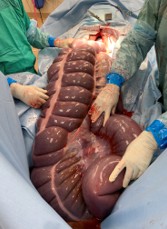
Colic surgery is performed to achieve a definitive diagnosis and to replace the colon back into the normal location. With a left dorsal displacement, the spleen can become injured which can lead to serious complications. Some displacements will require the surgeon to make an opening in the colon and to “dump” the contents to make the colon easier to replace and to eliminate any impaction (constipation) that may have occurred with the displacement. Many horses recover well once the colon is replaced and receive medical therapy for a few days after surgery.
Approximately one in four horses will experience repeat displacement over time. In some cases, your veterinary medical team may then offer a colopexy or a large colon resection. This is where the colon is tacked down to the body wall using sutures, or a large portion of it is removed. Both procedures can have serious complications, and it is very important that you talk with your horse’s veterinary team to determine if these options are the right choice for you and your horse.
Large Colon Volvulus
A true large colon volvulus cannot be resolved medically as the horse is often in extreme pain and becomes shocky and sick within a few hours of the twist. The horse has the best chance of survival if the problem is recognized, diagnosed quickly, and then undergoes surgery to untwist the colon. Toxins can build up in the colon when it loses blood flow, which can cause problems during surgery and after. In some cases, the large colon is removed, a procedure commonly known as a resection, to give the horse the best possible chance of survival.
Large Colon Displacement
If the horse resolves the displacement with medical therapy, a refeeding plan is usually used that involves feeding the horse increasing amounts of food over several days. Your veterinarian may also recommend supplementing electrolytes or monitoring your horse’s water intake during this time.
If your horse undergoes surgery to resolve the displacement, this may require medical therapy in a hospital for a few days after surgery to ensure that your horse is recovering well
Large Colon Volvulus
In many cases, horses require aggressive medical treatment after surgery and are at high risk of complications due to toxins circulating in the bloodstream, which can cause issues with blood clotting, laminitis (founder), and further colic lesions. Some horses develop adhesions, which are pieces of scar tissue that form between parts of the gastrointestinal tract, causing them to stick together and can cause future colic episodes.
Incisional Monitoring and Rest
The incision is usually made on the underside of their belly and requires close monitoring to ensure proper healing. Most horses can complete their recovery at home once they are eating and drinking normally but will require time off from riding or work for approximately 3 months after. It is very important to work with your veterinary medical team to determine the appropriate recovery recommendations for your horse and to follow them closely.
Premier Sponsors