
Updates on Past Research
Research Leads to Innovation
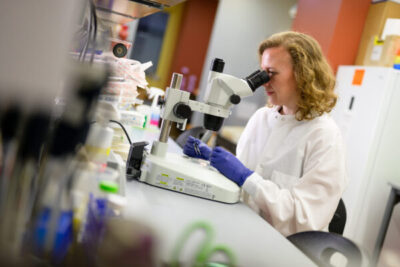
Recipients of Surgery Resident Research Grants and Diplomate Research Grants continue to push the boundaries of veterinary surgery. Their work today influences the care and treatment of animals tomorrow.
As for the future, your task is not to foresee it, but to enable it.
- Antoine de Saint Exupery, author
Bupivicaine liposomal injectable suspension as analgesia following limb amputation in dogs.
2019 Surgery Resident Research Grant, Alena Strelchik, BSA, DVM, DACVS (Small Animal), researcher
The study sought to determine if a long-acting local anesthetic would last as long as standard use of opioids after limb amputation in dogs. Forty dogs requiring amputation were randomly allocated between two different groups. Postoperative pain scores were equivalent at all time points except at six hours where the main pain score was lower in the local anesthetic group. In addition, the dogs in the local anesthetic group had less vomiting, less sedation, and ate sooner after surgery. The study provides evidence that a long-acting local anesthetic can dramatically decrease opioid use in an amputation pain management protocol.
Concurrent versus delayed exposure to corticosteroids in equine articular tissues cultured with local anesthetic.
2020 Surgery Resident Research Grant, Sophie Boorman, BVetMEd, DACVS (Large Animal), researcher
The study sought to answer the question “should surgeons wait to treat joints with steroids after instilling local anesthetic as part of a lameness investigation”. Some clinicians advocate for a period of joint rest between the local anesthetic and corticosteroid treatment; others prefer to treat joints with both medications concurrently. The study showed that in this model of equine arthritis, there is no difference between concurrent and delayed treatment protocols in terms of joint health.
In-vitro evaluation of an equine laparoscopic biopsy technique.
2021 Diplomate Research Grant, Amelia Munsterman, DVM, MS, PhD, DACVS (Large Animal), researcher
Surgical biopsies are necessary in horses for confirmation of gastrointestinal disease processes, including equine grass sickness, neoplasia, and inflammatory conditions. Intestinal biopsies obtained with surgical procedures such as laparoscopy are more likely to be diagnostic compared to endoscopic methods. However, laparoscopic biopsies carry the risk of complications including the development of peritonitis and scar tissue formation. The purpose of the project was to evaluate a novel laparoscopic biopsy technique to obtain samples from the small intestine and large colon using a combined suture loop and inverting barbed suture closure. This novel technique was compared to a traditional two-layer sutured biopsy technique to assess the security of closure and its effect on the size of the intestinal lumen. The results of the study show that the novel suture loop biopsy technique was as strong as the traditional biopsy method and equivalent in regard to the effect on the size of the intestinal lumen. This preliminary trial provides evidence that the suture loop biopsy technique may be a viable alternative to current methods for surgical biopsy.
Evaluation of high frequency irreversible electroporation (H-FIRE) for treatment of canine insulinoma.
2020 Diplomate Research Grant, Joanne Tuohy, DVM, PhD, DACVS (Small Animal), researcher
This study investigated the use of a new tumor ablation method, high frequency irreversible electroporation (H-Fire) to destroy cancer cells in canine insulinoma. The preliminary finding suggests that H-FIRE can be used to kill insulinoma cells. Further studies are needed to develop H-FIRE as a minimally invasive tumor ablation technique for dogs in insulinoma.
Generation of neotissue implants for equine tendon healing.
2020 Diplomate Research Grant, Mandi Lopez, DVM, MS, PhD, DACVS, researcher
Equine tendons do not heal well because tendon tissue has limited ability to heal in adults. The work of this study was to grow new equine tendon tissue from adipose (fat) stem cells in a custom laboratory system. Stem cells isolated from adult equine adipose tissue were grown on collagen material with standard or tendon nutrient liquid in specialized chambers called bioreactors for up to 21 days. The stem cells grown in tendon nutrient liquid turned into active tendon cells that were able to form new tendon tissue on the collagen material while the stem cells in standard nutrient material remained as stem cells. The tendon tissue grown in the laboratory could someday be used as a treatment to improve the healing in adult equine tendon injuries.
The efficacy and elution properties of premixed calcium sulfate antibiotic beads.
2020 Surgery Resident Research Grant, Emily Hartman, DVM, DACVS (Small Animal), researcher
In cases of orthopedic surgical site injections, bacteria can become resistant to antibiotic treatment due to a tendency for bacteria to cling to metal implants. Many times, these infections cannot be cleared unless the implants are removed, and the patient is treated with high doses of very powerful antibiotics. These medications can cause organ damage and add tremendous costs. As an alternative, there are beads that can be placed surgically and will give off high doses of antibiotics slowly as a type of local treatment of infection. Those products are currently only labeled to be formulated and used immediately, with recommendations to discard any leftovers. Unfortunately, depending on the type of antibiotic used, curing times can range from 15 minutes to several hours which adds on to the surgery time. This study looks at the shelf life of these products when stored, to be used in the future, to save both time and money. Antibiotic impregnated beads were formulated at one time in a sterile operating room, and, at three-month intervals, the beads were plated against challenge bacteria to demonstrate whether they were still effective or not. This continued up to one year’s time. The antibiotic activity was very similar regardless of the age of the bead, with little to no difference between the beads used immediately after they were formed (as is currently recommended) versus those beads that were used 12 months afterwards.